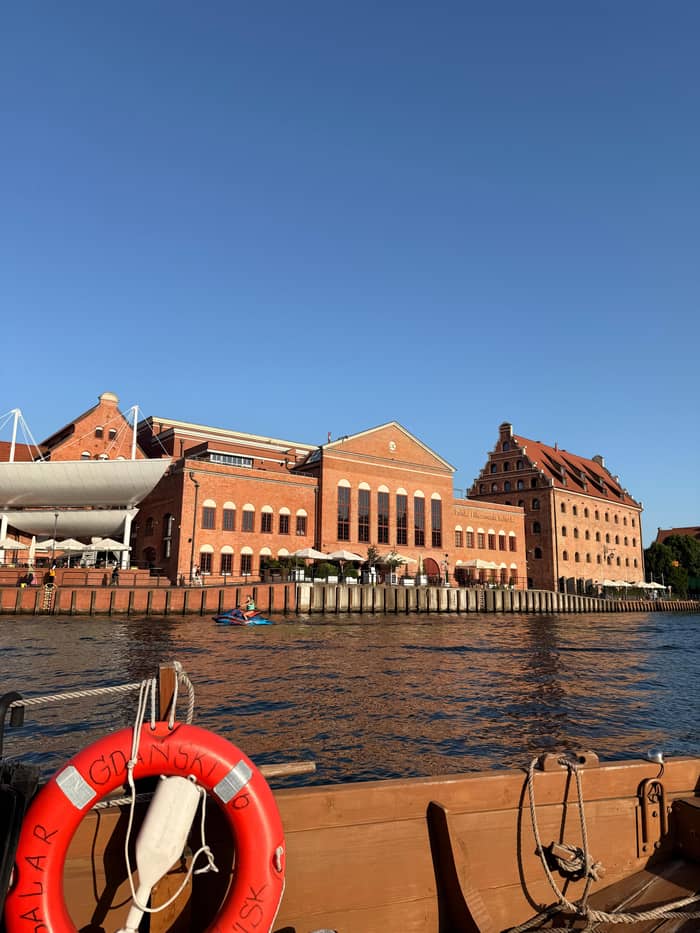
Wooden boat
Wooden galar
Shipyard, port and Old Town
- Length70 minutes
- GuidePolish, English
- Seats12
Explore the stops
Galar cruise through the shipyard and the Motlawa
★ 4.8 · 3,498 guest ratings
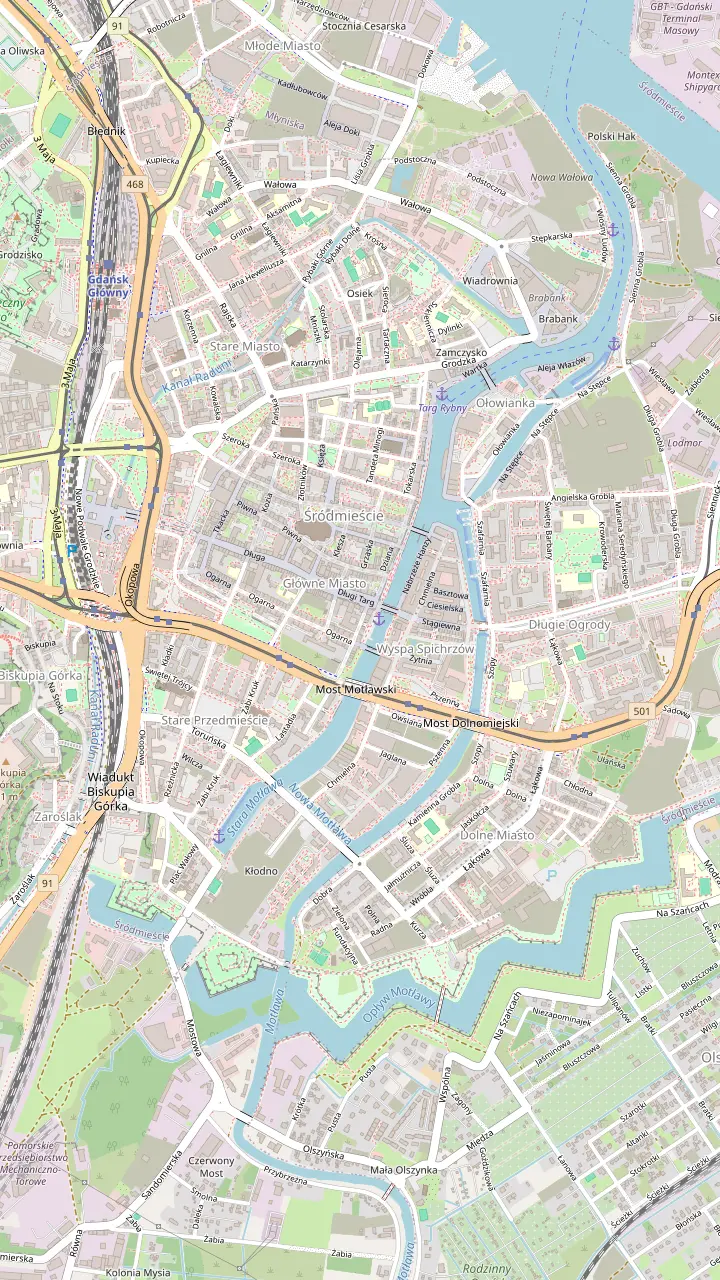
Map of 21 stops
Select a route, then tap a marker or stop to see its note and open Google Maps.
Raised in 1568-1571 as lodgings for visiting monarchs; Długa and Długi Targ run from here to the Golden Gate.
Google MapsThe riverside promenade with its line of Gothic water gates and the berths of the tourist boats.
Google MapsThe Gothic gate at the river end of Mariacka Street, the lane that runs up to St Mary's Church.
Google MapsBuilt in 1444 as gate and port crane; its treadwheels once lifted up to 4 tonnes.
Google MapsThe Nowa Motława and the Stara Motława split around the island and meet again by the Crane.
Google MapsThe museum's main exhibition fills three historic granaries; the permanent show is free on Wednesdays.
Google MapsFrom 1949 to 1981 this steamship made 1479 voyages with coal and ore, now a museum.
Google MapsThe philharmonic hall on Ołowianka, facing the moored Sołdek across the water.
Google MapsA Ferris wheel 50 metres high on Ołowianka; a ride lasts about 15 minutes.
Google MapsThe Teutonic mill on the Radunia Canal had 18 water wheels; the Amber Museum is inside now.
Google MapsThe early 17th-century lock where the Motława enters the centre; a mark records the flood of April 1829 on its wall.
Google Maps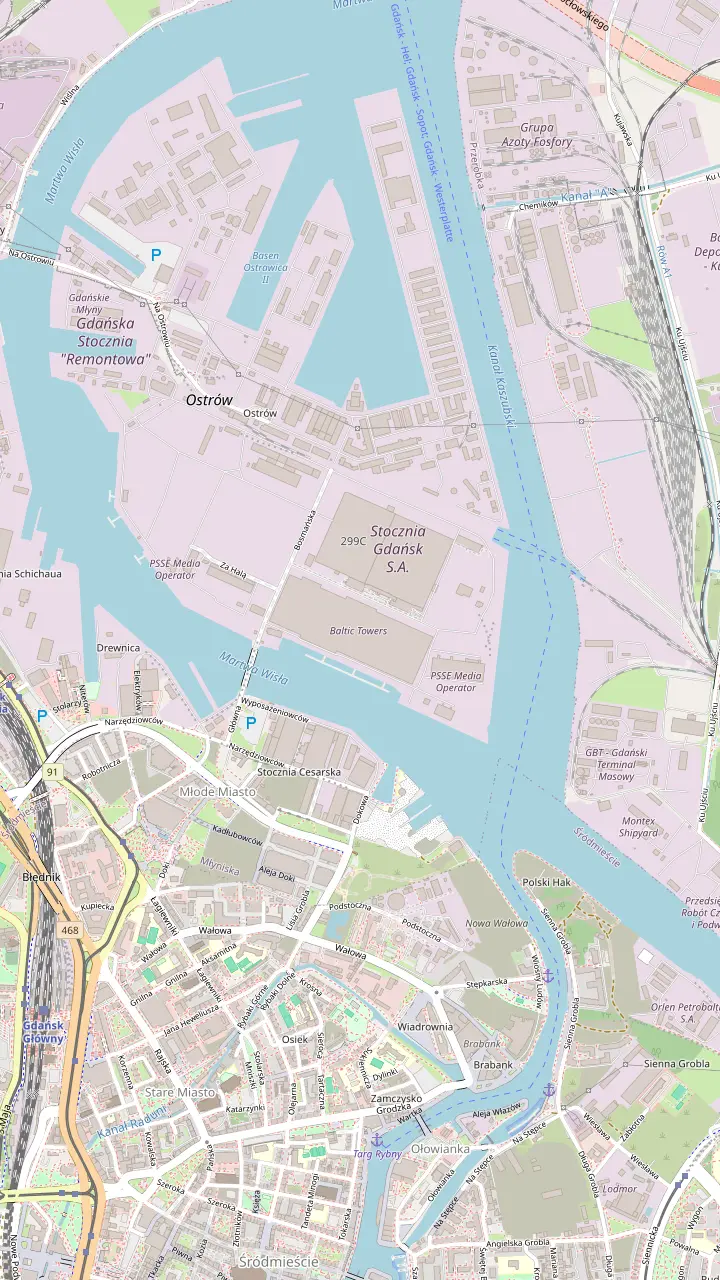
The galar's shipyard start: a marina made in an old shipyard dock.
Google MapsOnce a torpedo store of the Imperial Shipyard; the August 1980 agreement was signed in it.
Google MapsThe shipyard gate with the three 42-metre crosses of the 1970 monument beside it.
Google MapsThe headland named after the Polish raftsmen who brought grain; the harbour waters start here.
Google MapsThe island turned over to building submarines and torpedo boats in 1916, still a working yard.
Google Maps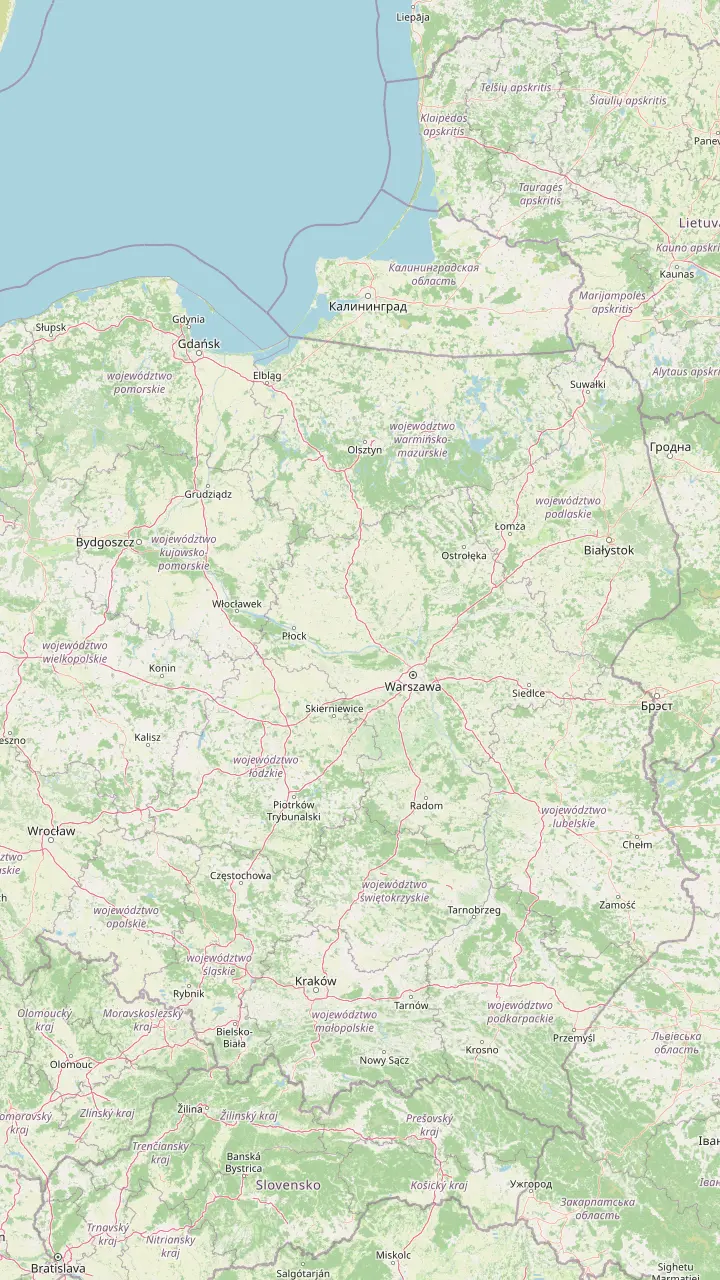
The headland named after the Polish raftsmen who brought grain; the harbour waters start here.
Google MapsA branch of the National Maritime Museum with boats, tools and models of Vistula trade, free on Saturdays.
Google MapsA river town on the rafters' road from Ulanów down to Gdańsk.
Google MapsOne of the Vistula grain ports on the way to Gdańsk.
Google MapsIts riverside grain store of Mikołaj Przybyła dates from the 16th century.
Google MapsThe capital of Polish rafting, where the Tanew meets the San; 724 km to Gdańsk by raft.
Google MapsMap © OpenStreetMap contributors
A Gdansk river tour follows the Motlawa from the old shipyard docks past the museum islands, the Crane and the water gates. This is what you pass, in order, and what each place was for.
Editorial team, gdanskboattour.click · Updated November 9, 2026 · Read in 8 min
A Gdansk river tour is really a tour of one small river doing a lot of work. The Motlawa enters the centre through the Kamienna Grodza lock and splits into a web of canals around Granary Island and Olowianka.2 In the middle of town it branches into several arms and channels, and the granaries, the Crane, the philharmonic hall and the old water gates all stand along them.5 That compact layout is why a short cruise can show so much.
The water is calm, and that shapes the whole experience. The current is so weak that kayakers paddle the river in either direction, admiring the old city as they go.6 For you, that means a steady ride with little rocking, even in a small open boat, and time to look up rather than hold on. The thing to watch is traffic: from the Crane onward the river is busy with vessels, the regional kayak trail notes.7
This page follows the galar cruise, the route the site's own tour sails, from its start at the former shipyard back up into the Old Town. The galar takes 70 minutes and its guide speaks Polish and English. Other city boats, from electric launches to catamarans, use parts of the same water, so the stops below also serve anyone planning a Gdansk river boat tour on another vessel. The river panel of the map shows every stop.
What you pass
| Landmark | Dates from | What it was |
|---|---|---|
| The Crane | 14443 | City gate and port hoist |
| Green Gate | 1568-157116 | Lodgings for monarchs |
| Kamienna Grodza | Early 17th century17 | Lock for the moats |
| Great Mill | Before 136418 | Teutonic mill |
| Soldek | 194919 | Coal and ore steamer |
Dates as the National Maritime Museum, the City of Gdansk, the Museum of Gdansk and the regional kayak trails give them.3,16,17,18,19
The galar can start at the former Gdansk Shipyard, one of its 2 boarding options. The regional kayak trail guide describes a marina built in an old shipyard dock here, at the point where the canalised Motlawa runs past the former shipyard grounds.1,12 The old shipyard grounds are set aside for a new district called Mlode Miasto, the Young City, so expect old brick halls next to new building sites.13
Just downstream is the headland of Polski Hak, named after the Polish raftsmen who floated the country's grain to Gdansk, and behind it the Motlawa meets the Martwa Wisla.8 The regional kayak trail warns that this is where harbour waters start, with heavy ship traffic.14 The regional tourism portal adds that the harbour canal here is for ships and needs a permit from the port authority.15
From the docks the galar turns upstream into the city. On the way the listing promises harbour cranes, working vessels and the port's inner wharf before the historic centre begins. The shipyard and harbour are covered in more depth on our page about the port and the shipyard seen from the water; on this stretch, simply watch how quickly the scenery shifts from steel and cranes to brick gables and church towers.
Time at each sight
Time at each sight as the 50-minute electric eco boat lists it on GetYourGuide; it starts and ends near the Green Bridge.
The first island you meet in the centre is Olowianka. Kayak guides pass it with its distinctive philharmonic hall and the permanently moored ship Soldek, and then slip under a drawbridge on the edge of the historic centre.9 The National Maritime Museum's main exhibition fills three historic granaries on the island.21 From the water you see their brick walls rise straight from the quay, which is the view the old cargo boats had.
The Soldek deserves an introduction before you sail past. The museum calls it the only steam-powered coal and ore carrier left in the world and the first prototype seagoing ship built in Poland after the Second World War.22 Between 1949 and 1981 it made 1479 voyages and carried more than 3.5 million tons of coal and iron ore.19 A note for this autumn: from 1 September to 15 November 2026 the ship runs a shortened visitor route during repairs.23
Above the island turns the AmberSky wheel, 50 metres high.20 A ride takes about 15 minutes, a good way to see the river you have just sailed from above.24 Between the museum's buildings on either bank runs a small ferry called Motlawa, so you can cross to the Crane without walking round by the bridges.25 If you plan a museum visit, the permanent exhibition in the granaries is free on Wednesdays.26
Pick your stretch
The boats share the water but not the whole route.
If I want the shipyard and the port too
The galar
Its route adds the shipyard, port cranes and the inner quay.
If I want a quiet, small boat
The electric eco boat
Up to 8 guests, with blankets on board.
If I need commentary in German
The river catamaran
Its guide speaks English, German and Polish.
If I want to see it all from above
AmberSky after the cruise
A 50-metre wheel on Olowianka.20
If I want to paddle it myself
A guided kayak tour
2 hours of kayaking through the Main City.
Boats on this water
Wooden boat
Shipyard, port and Old Town
Electric
Water gates and Granary Island
Catamaran
Old Town loop
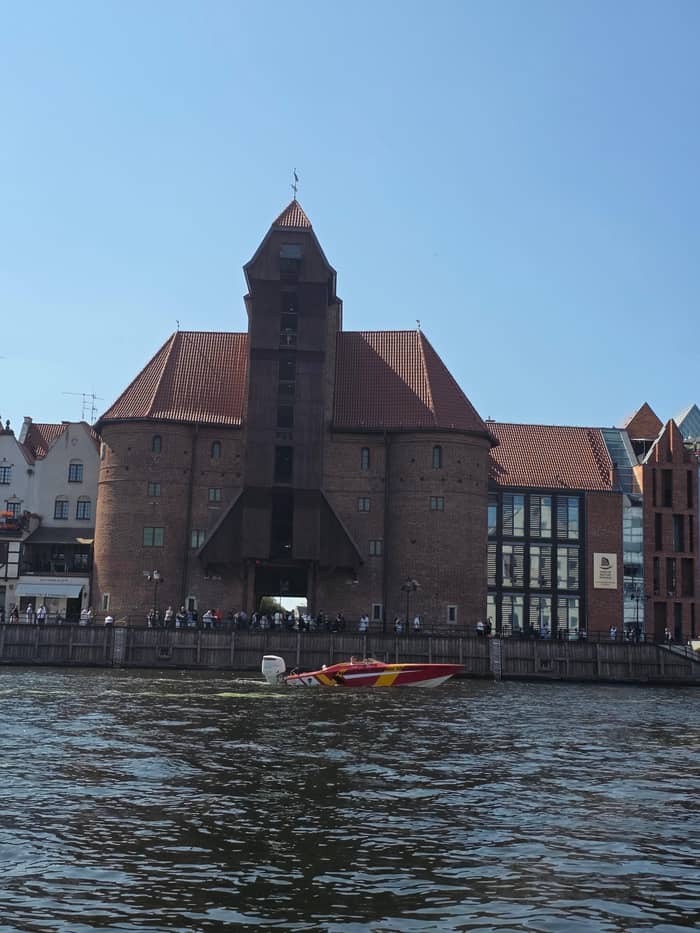
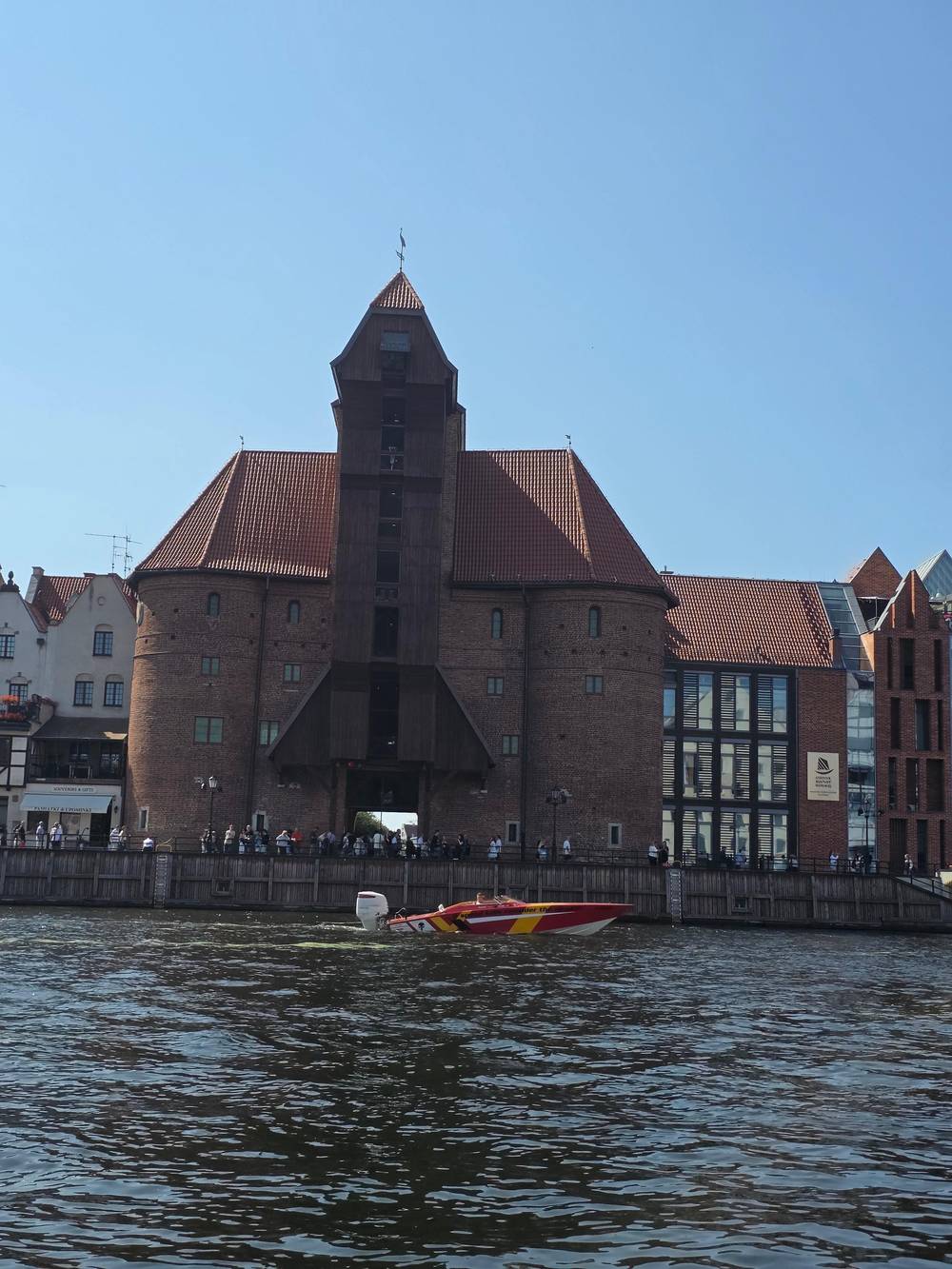
Across the water rises the Crane, the building you will have seen on postcards long before you arrive. The National Maritime Museum's leaflet gives it a building date of 1444 and calls it the largest and oldest surviving port crane in Europe.3 The city's monuments page dates its present form to the years 1442-1444.44 Its shape comes from doing both jobs at once, city gate and harbour crane, which is why you see brick towers either side of a timber hoist.45
The hoist explains the building. The city describes how it loaded cargo and stepped masts into ships, while also serving as a gate.46 Inside, four treadwheels of 6 and 6.5 metres across were turned by human legs to raise the loads.47,48 The museum says the reconstructed machinery once lifted up to 4 tonnes.10 From a boat you look straight up at the timber gallery where those wheels sit, which is the angle the ship crews had.
Look for the details the restorers brought back. A 17th-century sundial on the southern tower survived the war and has been restored.43 The timber hoist is now a lighter brown than the near-black it wore before the works.49 The foundations lie below river level, and during the work a stone was found marking the flood of 1651 in the Zulawy delta.50,51 Visiting? The wooden mechanism is currently closed and a reduced ticket applies.52
Price the river
Choose a boat and say how many are coming.
Review 4 options
Choose a boat and say how many are coming.
≈
View≈
View≈
View≈
ViewFigures are GetYourGuide from-prices, translated at the ECB reference rate. The booking step shows what you pay exactly.
Stop by stop
Imperial Dock
Boarding in a marina built in an old dock.1
Polski Hak
Named after the Polish grain raftsmen.8
Olowianka
Granaries, the Soldek and the philharmonic.9
The Crane
Treadwheels once lifted up to 4 tonnes.10
Long Embankment
A row of Gothic gates on the promenade.4
Granary Island
Two river arms meet again at the Crane.11
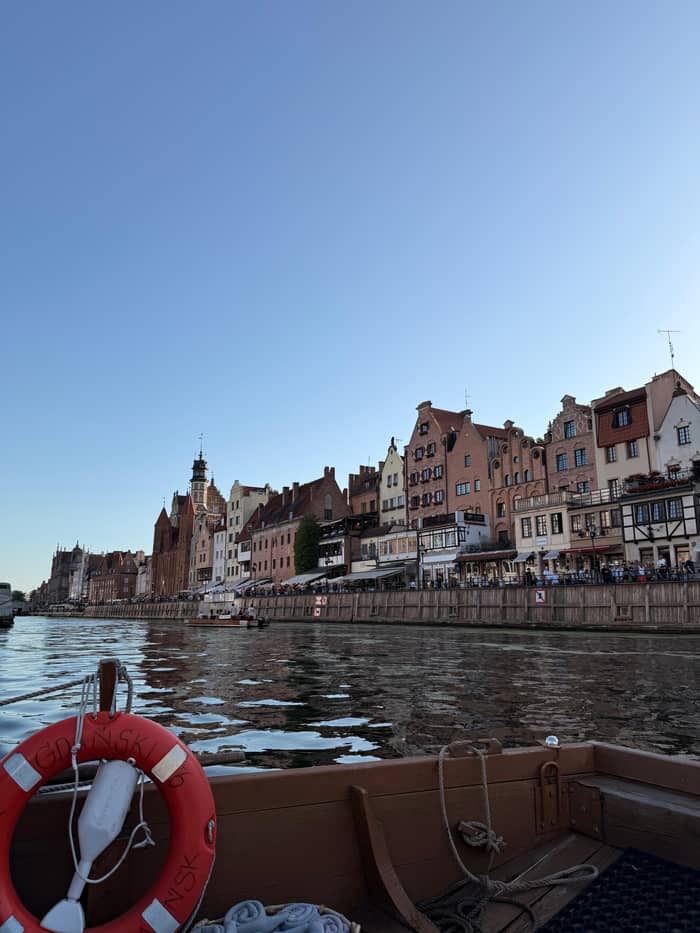
Past the Crane the river runs beside the Long Embankment, today a promenade with the berths of the tourist boats.7 Along it stands a row of Gothic water gates from the Middle Ages, each one the end of a street running down from the city.4 The electric eco boat's listing picks out several of them, the St Mary's, Straganiarska, St John's and Holy Spirit gates, along its route, a handy list to tick off as you pass.
St Mary's Gate is the easiest to place: it closes the river end of Mariacka Street, the lane that climbs to St Mary's Church.28 At the southern end of the embankment the Green Gate was built between 1568 and 1571 as lodgings for visiting monarchs.16 From it Dluga and Dlugi Targ run inland to the Golden Gate, the old Royal Route.27 From the water, the Green Gate frames that whole axis.
Almost everything you see here was rebuilt. Taken in March 1945, Gdansk was turned into a sea of ruins, then restored over decades by builders, conservators and artists.53 Knowing that changes how the waterfront reads: the gables are faithful reconstructions, and the river is one of the few things that never moved. Ask your guide which facades follow old drawings and where the rebuilders took liberties; it is a good question to put on the water.
Video
walkthrough it now! on YouTube · Nothing is fetched until you hit play.
The river enters the centre of Gdańsk through Kamienna Grodza, branching out into a network of canals around the Isles of Spichrzów and Ołowianka
On the water
Granary Island sits between arms of the river: the Nowa Motlawa runs straight on and the Stara Motlawa bends left, and the arms meet again at the Crane.11 On a Gdansk city boat tour you often loop the island, with ruined and rebuilt granaries along its banks. The island's name gives away its old job as the city's storehouse, and its quays face the Long Embankment across the water.
Further upstream is the Kamienna Grodza lock, a water structure from the early 17th century that could divert the Motlawa into the city moats during a siege.17 On its wall a high-water mark records the level reached in April 1829, in one of the biggest floods in its history.31 Kayakers can carry on past it on an 8 km loop that runs back round through the old moats.54 On a city cruise you see the lock's waters only from a distance, if at all.
One more water story sits just off the route. The Radunia Canal and the Great Mill on it date from the time of the Teutonic Order.55 The mill, built before 1364, ran until the end of the Second World War and was rebuilt in 1962.18 It once turned 18 water wheels, each 5 m across, a feat of medieval engineering on a city canal.29 Today it houses the Amber Museum, a short walk from the river and a good place to end the day.30
The route is the same water for every operator, but the boats differ. The galar is the wooden one, 12 seats, 70 minutes, wheelchair accessible by its listing. The electric eco boat is smaller still, limited to 8 guests on a 50-minute loop from near the Green Bridge, with pillows and blankets on board. On the electric boat you hear the water and the gulls rather than an engine.
If you want a guide in German, the 45-minute catamaran cruise has commentary in English, German and Polish, and it sails rain or shine. A 45-minute river yacht from the same Green Bridge stop takes no more than 10 guests. The eco boat's listed loop also touches the shipyard and the marina, but of these four boats only the galar lists the harbour itself among its sights. For a Gdansk river tour that wants the working harbour as well as the Old Town, that settles it.
Prices sit close together: all four boats here, the galar included, start from about €19. Each refunds in full if you cancel 24 hours or more ahead. So choose by the stretch of river you want and the size of boat you are comfortable in, not by a few cents. Whichever you pick, book a slot that leaves time to walk the embankment afterwards, because the gates and the Crane reward a second look on foot.
FAQ
It has 2 starting options, depending on the ticket you book.
The galar route names the 15th-century wooden crane among its sights.
A row of Gothic water gates lines the Long Embankment.4
Its current is weak enough to paddle both ways.6
Poland's first postwar prototype seagoing ship, now a museum.22
The catamaran takes 45 minutes and the galar 70.
Its wooden mechanism is closed and a reduced ticket applies.52
Sources
Read next
Planning a boat on the Motlawa? Ask a real person here.